As a State-CAPE organization, WFIS participates in the annual spring Council for American Private Education meeting, which includes other state CAPES and CAPE’s national board of directors.
There was considerable breadth to the topics discussed. The attendees were briefed on issues facing other states, such as overburdensome regulations proposed in Virginia and Florida, and threats to the long-term funding for private schools in Minnesota. These conversations provided insight into legislators’ deflection of attention away from necessary changes needed in public education systems in their states and towards private education.
Other topics included the Federal Scholarship Tax Credit. This discussion was initiated by a presentation by Jorge Elorza, the Chief Executive Officer of Democrats for Education Reform. He described opting into the program as a “no-brainer” with significant benefits to both public and private school students. His analysis of the amount of funding that could be re-cooped for states from this program was staggering. If you are interested in knowing more, read his comments here.
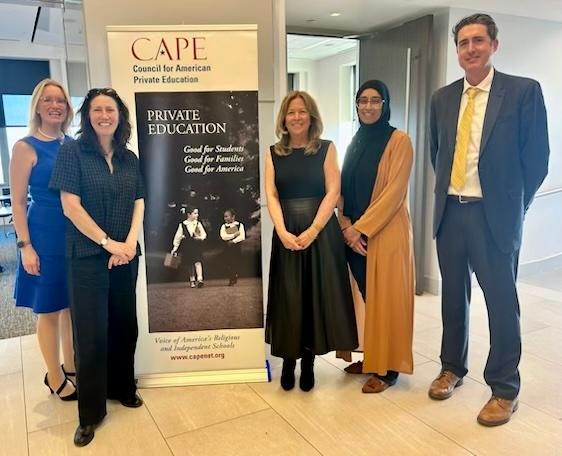
Image left to right: Kristin Smith, Fisher Phillips; Suzie Hanson, WFIS; Laura Colangelo, Texas Private Schools Association; Shaza Khan, Islamic Schools League of America; and Michael Schuttloff, Exec. Dir. of CAPE.
The group discussed artificial intelligence and education, which began with a presentation by Micah Shippee, Director of Education Technology Consulting and Solutions at Samsung. Schools shared the ways AI is changing communication among teachers and students, and among administrators and parents. There is consensus that curriculum development could be enhanced and made more efficient through the use of AI, but AI is still making up much of the information, making its use unreliable.
CAPE’s policy committee members, Whitney Silverman, NAIS attorney, and Sister Dale McDonald, briefed the group on changes to the Federal Title Funds program, outlining cuts, program consolidations, and Federal Interagency Agreements that are altering the nature of equitable services.
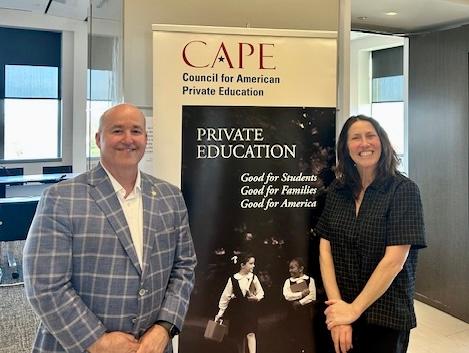
Image left to right: Larry Taylor of ACSI, newly elected board chair of CAPE and Suzie Hanson, WFIS.
The reduction of the U.S. Department of Education forced the division of responsibilities among many federal agencies, and interagency agreements are making transparency difficult. The ways in which Title Funds will be distributed, and to whom, remain to be seen. CAPE is advocating for equity, flexibility, and transparency.